


5-Inch vs 6-Inch Eavestrough: GTA Sizing Guide
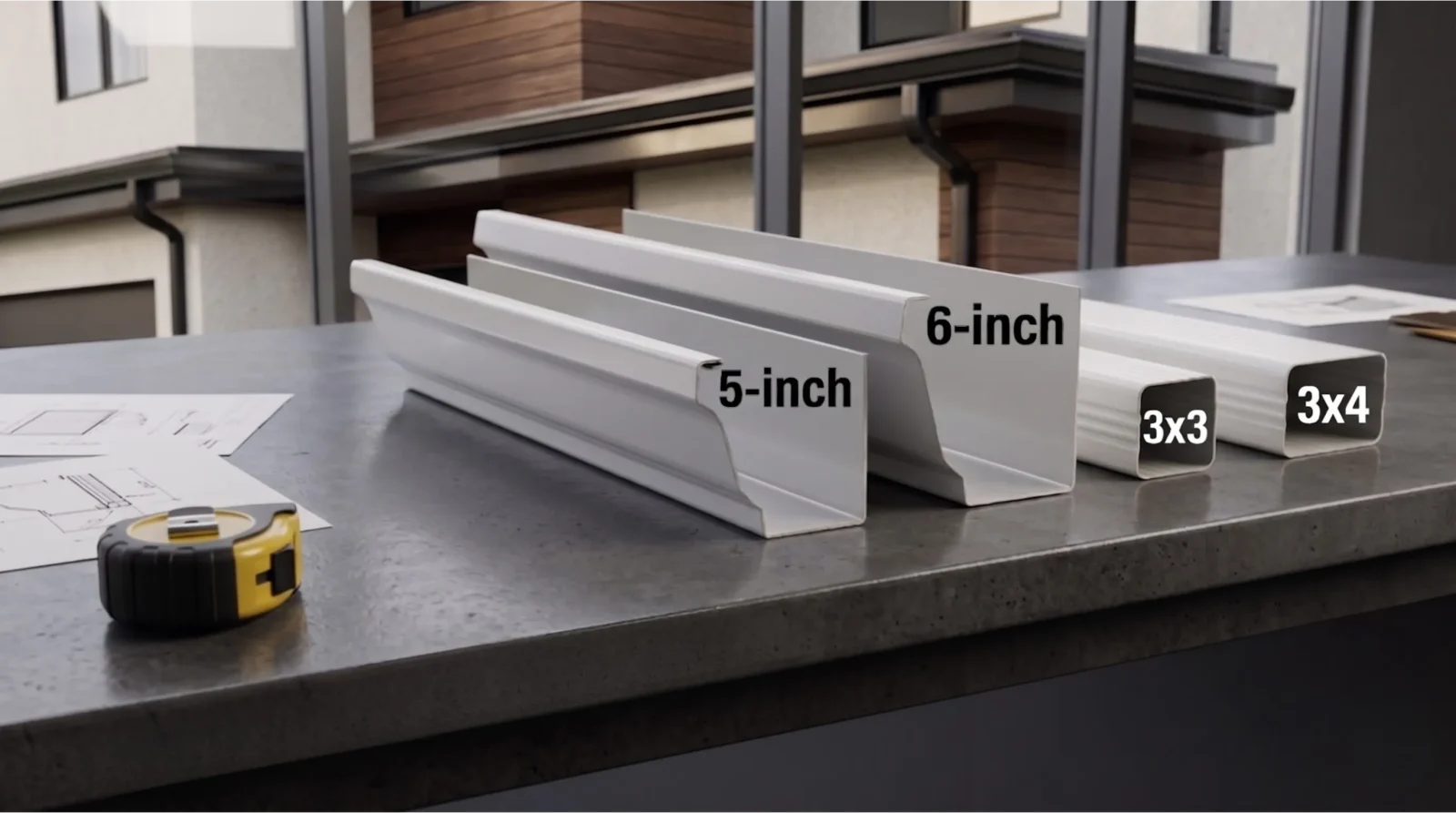
5 vs 6 inch eavestrough: a 6-inch profile provides more capacity, but a sound 5-inch system may already meet your home’s needs. The choice depends on roof runoff, gutter layout, outlets and where the downspouts discharge.
This guide helps Mississauga and West GTA homeowners compare the options before requesting a quote.
Quick answer: bigger helps only when the drain can keep up
A lot of homeowners assume that overflowing gutters automatically mean “I need bigger gutters.” Sometimes that is true. But many overflows happen because water cannot leave the gutter fast enough. The real problem may be the downspout size, the outlet location, the number of downspouts, the gutter slope, or a restricted underground connection.
Think of it like a sink. A bigger sink holds more water, but if the drain is too small or partly blocked, it still overflows. Your roof is the faucet, your eavestrough is the sink, and your downspouts are the drain. The best system is not always the biggest one — it is the one where every part works together.
Which setup is worth considering?
| Situation | Option to assess | Why |
|---|---|---|
| Simple roofline, average roof area, asphalt shingles | 5-inch eavestrough + 3×3 downspouts | Clean, practical, and enough for many standard GTA homes when installed correctly. |
| Larger roof, valleys, steep roof sections, repeated overflow | 6-inch eavestrough + 3×4 downspouts | Best performance when water can discharge freely above ground or into a properly sized drainage path. |
| 6-inch eavestrough reconnecting to an existing 4-inch round underground drain | Assess the drain and transition before choosing downspouts | Pipe diameter alone does not establish capacity or permission to reconnect. Check the outlet, adapter, pipe condition and discharge destination. |
| One problem corner or one overloaded run | Add or relocate a downspout first | Sometimes layout fixes solve the issue without upgrading the whole house. |
What determines gutter size?
GTA storms can put a lot of water onto a roof in a short time. That does not mean every house needs the biggest eavestrough available, but it does mean homeowners should stop thinking of gutters as “just trim.” A properly sized eavestrough system helps move roof water away from fascia, soffit, brick, siding, walkways, and the foundation.
Professional gutter sizing is not based on gutter width alone. It considers roof area, rainfall intensity, gutter length, roof pitch, outlet placement, number of downspouts, and where the water discharges. That is why we size the full system — not just the front face of the gutter.
Related service: Eavestrough (Gutter) Installation & Repair.
What changes when you go from 5-inch to 6-inch?
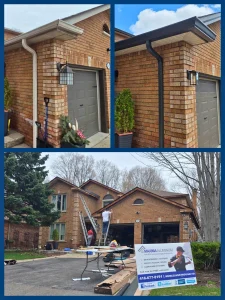
Both 5-inch and 6-inch eavestroughs are commonly used on residential homes. The difference is not just “one inch.” A 6-inch profile is deeper and wider, giving it more room to catch and carry water during heavy rain.
That extra capacity can help in real GTA situations like:
- Valley dumps: two roof planes send water into one small area.
- Steeper roofs: water reaches the gutter faster.
- Long gutter runs: water has to travel farther before it reaches a downspout.
- Wind-driven rain: a larger opening gives the system more margin.
- Recurring overflow: especially when gutters overflow even after cleaning.
However, gutter size is only one part of the system. If the downspouts are too small, too few, poorly placed, or tied into a restricted drain, the system can still overflow. The restriction still needs attention.
Our downspout standard: 3×3 for 5-inch, 3×3 or 3×4 for 6-inch
We assess gutter and downspout sizes together. Common combinations include:
- 5-inch eavestrough: usually paired with 3×3 inch aluminum downspouts.
- 6-inch eavestrough: can be paired with 3×3 or 3×4 inch downspouts, depending on the roof and drainage path.
- Best open-drainage performance: 6-inch eavestrough + 3×4 downspouts.
A 3×4 downspout has a larger cross-section than a 3×3 downspout. They are a strong choice for high-volume roof sections, steep roofs, long runs, and valleys. When the downspout drains above ground through a proper extension, splash pad, or open discharge area, 3×4 is usually the best pairing with 6-inch eavestrough.
For downspout work, see: Downspout Installation & Repair.
The important exception: underground drains, French drains, and weeping tile connections
This is the part homeowners rarely think about until installation day. A downspout does not stop at the wall. It has to connect to something: an extension, splash block, rain barrel, pop-up drain, underground pipe, or existing drain connection.
Many homeowners call any underground pipe a “French drain” or “weeping tile.” That language can be confusing. In practice, there is a big difference between:
- An underground roof-leader drain: intended to carry roof water away from the house.
- Perforated foundation weeping tile: intended to collect water around the footing or foundation.
We do not recommend sending roof water into perforated foundation weeping tile. That can add water exactly where you are trying to keep the foundation dry. If the home already has an existing underground connection, it should be assessed carefully before reconnecting.
An existing 4-inch underground pipe does not automatically call for a 3×3 downspout. Check the pipe’s purpose, condition, slope and destination, along with the proposed adapter. Do not choose a smaller downspout simply because it is easier to connect.
Before reconnecting, confirm the local requirements. For Toronto properties, consult the City’s downspout disconnection guidance. A suitable fitting cannot make an unsuitable drainage connection acceptable.
When to consider 6-inch eavestrough with 3×4 downspouts
Choose this setup when the home needs more capacity and the water has a clear path after it leaves the downspout.
- You have valleys dumping heavy water into one run.
- Your gutters overflow in heavy rain even when clean.
- The roof is steep or sheds water quickly.
- The downspout can drain above ground through a proper extension or splash pad.
- The underground drain is properly sized and the transition will not create a restriction.
- The assessment confirms that the existing gutter capacity is insufficient.
This combination provides more capacity when the rest of the drainage path can accommodate it. If the roof sends a lot of water to one area, 6 inch eavestrough and 3×4 downspouts give the system more breathing room.
Can 6-inch gutters use 3×3 downspouts?
They can, where the roof runoff and outlet layout support that choice. The size of an existing underground connector is not enough to decide. Some homes may need different downspout sizes on different roof sections; assess each section and its discharge path.
When 5-inch eavestrough with 3×3 downspouts is enough
Not every home needs 6-inch. A properly installed 5-inch eavestrough with 3×3 downspouts can perform very well on many homes in Mississauga, Oakville, Brampton, Etobicoke, Milton, Burlington, Vaughan, North York, and Toronto.
5-inch is usually enough when:
- The roofline is simple and not overly steep.
- There are fewer valleys and no major water-dump zones.
- The home has average roof areas per run.
- The current system only overflows when clogged with leaves.
- The main issue can be solved by better slope, better outlet placement, or one additional downspout.
In these cases, spending extra on 6-inch may not deliver enough benefit. The smarter investment may be better installation details.
One extra downspout can sometimes beat a full upgrade
Here is a real-world example: one long gutter run carries water from a large roof area all the way to one corner. During heavy rain, that corner overflows. A homeowner may think the entire house needs 6-inch eavestrough.
Sometimes the better fix is simpler: add another outlet and downspout in the right place. This divides the water load, shortens the travel distance, and lets the system drain faster.
That is why a good assessment matters. We look at where water collects, not just what size gutter is already installed.
Signs your current eavestrough is undersized or poorly designed
Walk around the house after a heavy rain and look for these clues:
- Water spilling over the front even when gutters are clean.
- Overflow at one inside corner below a roof valley.
- Dark streaks on fascia, soffit, siding, or brick.
- Water overshooting the gutter during wind-driven rain.
- Gurgling or surging at the downspout outlet.
- Standing water in the gutter after rain stops.
- Water pooling beside the foundation.
- Ice buildup where the downspout discharges in winter.
If you see staining on brick, this related article may help: Brick Stains from Gutters: Causes & Fixes.
Installation details that matter more than size
A well-installed 5-inch system can outperform a poorly installed 6-inch system. These details make a huge difference:
1. Proper slope
Gutters need enough pitch to move water, but not so much that the system looks crooked from the street. On long runs, slope and outlet placement must be planned together.
2. Outlet placement
The outlet is where water enters the downspout. If the outlet is too small, poorly cut, or placed too far from the main water load, overflow can happen even with a larger gutter.
3. Strong hidden hangers

GTA winters are hard on eavestroughs. Snow, ice, and freeze-thaw can loosen weak systems. Proper hidden hangers and secure fastening keep the run aligned and reduce sagging over time. We recommend Alu-Rex T-Rex or DoublePro continuous hangers.
4. Solid corners and seams
Corners handle heavy water flow and movement. A weak corner can leak, stain fascia, and drip onto steps, patios, or walkways. If you want to understand this better, read: Eavestrough Corners – Box vs Hand-Mitered Seam.
5. Drip edge
If water runs behind the gutter instead of into it, upsizing the eavestrough will not solve the real problem. The roof edge must direct water properly. Learn more here: Roof Drip Edge for Gutters: Why It Matters.
6. Fascia and soffit condition
Gutters are only as strong as what they are attached to. If fascia is soft or damaged, the system can sag no matter what size you choose.
What about gutter guards?
Gutter guards can be helpful when the real issue is leaves, seeds, pine needles, or debris. They can reduce clog-related overflow and make maintenance easier.
But guards do not fix:
- Wrong slope
- Too few downspouts
- Undersized outlets
- Restricted underground connections
- Water overshooting from a valley
If debris is the main problem, see: Gutter Guards Installation.
If water volume is the main problem, the better fix may be 6-inch eavestrough, 3×4 downspouts where appropriate, a new outlet, or an extra downspout.
How much does 5-inch vs 6-inch eavestrough cost?
The cost difference between 5-inch and 6-inch eavestrough depends on the total linear footage, height/access, number of corners, fascia condition, downspout size, and whether any downspouts need to reconnect to underground drains.
A 6-inch system usually costs more than a 5-inch system because the material profile is larger, the work is heavier, and the system may require larger outlets or 3×4 downspouts in high-flow areas. However, the right choice depends on the house — not just the price per foot.
For homeowners who want a clearer idea of pricing before booking an assessment, we created a separate guide here: Eavestrough Cost & Price Guide for 5-inch and 6-inch gutters.
That page is the better place to compare budget ranges, while this guide helps you understand which system makes sense for your roof: 5-inch with 3×3 downspouts, 6-inch with 3×3, or 6-inch with 3×4 downspouts.
What to note before requesting a quote
Before you request a quote, ask yourself these questions:
- Does water overflow even after the gutters are clean?
- Is the overflow mostly at one corner or valley?
- Do you have long gutter runs with only one downspout?
- Does your roof look steep compared to neighbouring homes?
- Do downspouts connect into underground 4-inch round pipes?
- Do you see brick staining, fascia staining, or splashback near the foundation?
Any recurring overflow or drainage problem is worth investigating. These observations help with an assessment; counting symptoms does not determine the correct gutter size.
FAQ: 5 vs 6 inch eavestrough in Ontario
Is 6-inch eavestrough always better than 5-inch?
No. 6-inch gives more capacity, but it is not automatically necessary. A properly installed 5-inch eavestrough with 3×3 downspouts works well on many standard GTA homes.
What downspouts do you use with 5-inch eavestrough?
For 5-inch eavestrough, our standard setup is typically 3×3 inch aluminum downspouts. This is a strong, clean residential option for many homes.
Do 6-inch gutters always need 3×4 downspouts?
No. Either size may be suitable, depending on roof runoff, outlet layout and the discharge path. An existing underground connector alone should not determine the downspout size.
Why would you install 3×3 downspouts on a 6-inch eavestrough?
A 3×3 downspout may suit a roof section when its expected runoff and outlet layout support that choice. Do not reduce the downspout size solely to fit an existing drain. Assess the connection and downstream drainage first.
When is 3×4 the best choice?
3×4 is usually best with 6-inch eavestrough when there is heavy roof flow and the downspout can discharge through an extension, splash pad, or properly sized drainage path without a restrictive adapter.
Can adding a downspout solve overflow without upgrading to 6-inch?
Yes. If the problem is one overloaded run or one poor outlet location, adding or relocating a downspout can sometimes solve the issue more efficiently than replacing the whole system with larger gutters.
Should downspouts connect to weeping tile?
Roof water should not be sent into perforated foundation weeping tile. If an existing underground connection is present, it should be checked carefully to confirm where it drains and whether it is appropriate for roof water.
Will gutter guards stop overflow?
Only if the overflow is caused by debris. Gutter guards will not fix poor slope, undersized outlets, too few downspouts, or a restricted underground drain connection.
Where can I check the cost of 5-inch or 6-inch eavestrough?
You can start with our Eavestrough Cost & Price Guide. It explains the main pricing factors for 5-inch and 6-inch eavestrough systems, including downspouts, access, corners, and project scope.
If you are in Mississauga, Oakville, Brampton, Etobicoke, Milton, Burlington, Vaughan, North York, Caledon or Georgetown, send us a few photos of your roofline, valleys, downspout locations, and any underground drain connections. Photos help us identify what to inspect. Final sizing depends on measurements and a review of the drainage path.
If you are still comparing budgets, start with our Eavestrough Cost & Price Guide. Then contact us when you are ready for a property-specific recommendation.
Request a Free Eavestrough Sizing Assessment
Call 416-677-8191